
The Minimum Viable Program
Every program you've tried was designed for someone with more time, more energy, and a calmer life than yours.

Every program I’ve ever seen makes the same assumption.
That you will show up as your best self. That your week will cooperate. That when Monday arrives, you’ll have the energy, the time, and the mental clarity the program demands. That the version of you who signed up on a hopeful Sunday evening is the version who walks in on Wednesday morning after a bad night’s sleep and a difficult meeting.
That person doesn’t exist.
They never did.
This is why programs fail people who have every intention of following them. Not because the program is bad. Not because the person is weak. But because the program was designed for someone else. Someone with fewer obligations, fewer interruptions, and a life that bends around training rather than training that bends around life.
What follows is not that program.
Before the prescription, the principles.
These are not motivational. They are structural.
Get these wrong and it doesn’t matter what program you follow.
Build capacity before intensity.
Most programs start with intensity. Heavy weights, hard intervals, maximum effort from week one. This is exactly backwards.
Capacity is your ability to absorb and recover from training. Without it, intensity doesn’t build you. It breaks you.
The chronic restarter who goes hard after a long break almost always collapses within three weeks. Not because they lack willpower. Because their body wasn’t ready for the load.
Start easier than you think you should.
Stay there longer than feels comfortable.
Then add intensity.
Don’t hurt yourself.
This sounds obvious. It isn’t. The fitness industry has spent decades convincing people that pain is the price of progress. It isn’t. Pain is a signal. Discomfort is the price of progress. Learn the difference.

Discomfort is your lungs working hard. Your muscles fatiguing. Your body adapting to a new demand.
Pain is your body telling you something is wrong.
One builds you. The other breaks you. Never confuse them.
Technique before load.
Always. Without exception. A heavy squat with poor technique is not a squat. It’s a slow injury. A pushup with a collapsed chest is not a pushup. It’s practice for dysfunction. Every repetition is practice. You are teaching your body a pattern. Teach it the right one, even if that means going slower, going lighter, doing less.
No pain, no gain is the most expensive lie in fitness.
Great technique, consistent practice, appropriate load - that’s how you progress.
Get out of your comfort zone. Carefully.
The opposite of “no pain no gain” is not “never challenge yourself.” You have to do hard things. You have to push. The edge is where adaptation happens.
But the edge is not the cliff.
Find where your body is genuinely challenged. It could be breathing hard, muscles working, attention required. And Stay there.
That’s enough. You don’t need to go past it.
Have fun. Or at least don’t dread it.
This one gets dismissed as soft. It isn’t.
Dread is a dropout mechanism. If you hate every session, your body will find reasons to skip them. Fun is not a luxury. It is a retention strategy. It doesn’t have to feel like a party. It has to feel like something you’d willingly do again.

Find movements you don’t hate. Find a setting that doesn’t feel punishing. Find a pace that feels sustainable. Joy is fuel. Don’t waste it.
The minimum viable week.
Two to three days of resistance training. The other days, you move.
That’s the skeleton. Here’s what it looks like in practice.
A strong day: You have time and energy. You do your full session. Five movement patterns: you push something, you pull something, you hinge, you squat, you carry. Forty-five minutes. Reasonably hard. Not destroyed.
You leave with something left in the tank.
A medium day: Life has taken the edge off. You do ten to fifteen minutes of core work and a twenty-minute walk. That’s it. It counts. You stayed in the game.
A rough day: You’re running on empty. You do ten minutes of stretching. Or breath work. Or you walk around the block once. Something. Anything. The only rule is you don’t go to zero.
A rest day: You actually rest. Sleep. Eat well. Let the body recover. Recovery is not the absence of training. It is training.
A real week might look like this:
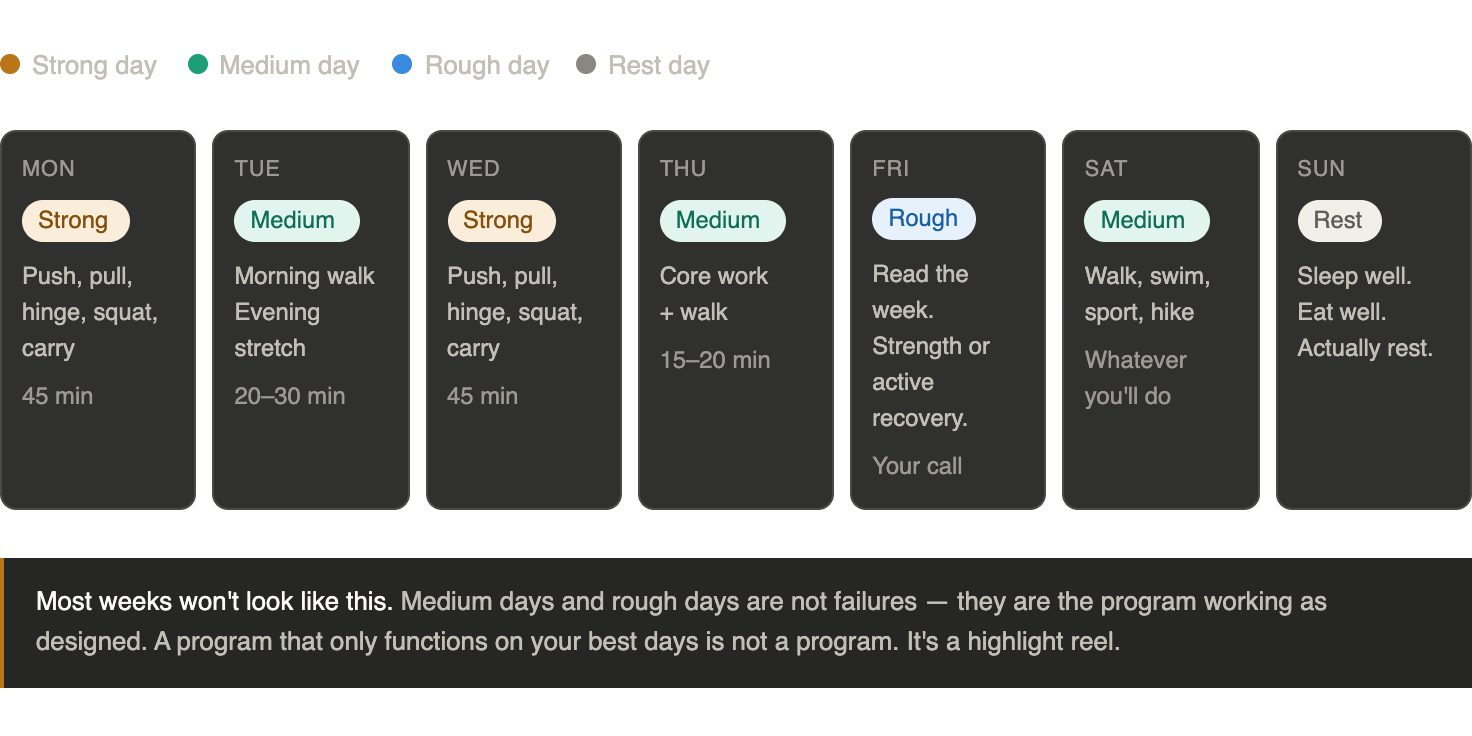
Some weeks this is exactly what happens. Most weeks it isn’t. That’s fine.
The medium days and rough days are not failures. They are the program working as designed. A program that only functions on your best days is not a program.
What this builds toward.
Follow this for six months and something shifts.
Not dramatically. Not overnight. Quietly.
You’ll notice you’re not as tired at the end of the day. That you can carry the groceries without thinking about it. That the stairs don’t announce themselves. That you bent down to pick something up and didn’t notice.
That’s independence arriving. Not with fanfare. Quietly. But surely.
The goal was never to become an athlete. The goal was always to have a body that handles your life. Strength sessions twice a week. Movement daily. Capacity before intensity. Technique before load. No program that asks for more than you currently have.
This is the minimum. Which means it is also the foundation.
Everything else gets built on top of this.
One question: Which principle are you currently violating? Intensity before capacity? Skipping the medium days entirely? Tell me in the comments.
Very well articulated 👏